2026 National Industrial Investment Midyear Outlook: Key Takeaways for Investors
 Marcus & Millichap 2026 National Industrial Investment Midyear Outlook
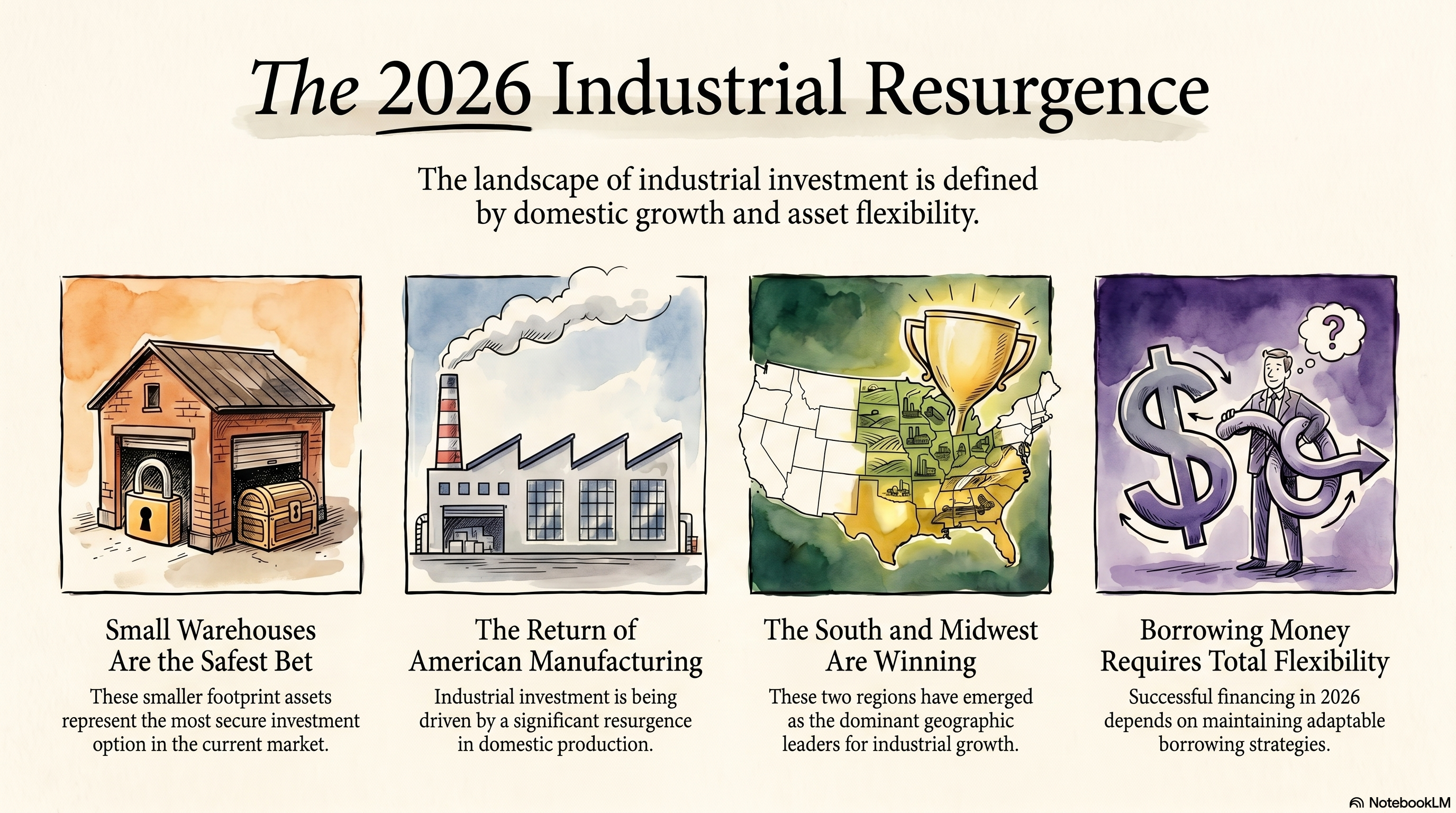
Key Takeaways for Investors
- Small Warehouses Are the Safest Bet
- The Return of American Manufacturing
- The South and Midwest Are Winning
- Borrowing Money is All About Flexibility
Small Warehouses Are the Safest Bet
Right now, buildings between 10,000 and 50,000 square feet have a very low vacancy rate of just 4.2 percent. In contrast, massive buildings between 200,000 and 750,000 square feet have a much higher vacancy rate of 11.1 percent, and buildings over 750,000 square feet sit at an 8.8 percent vacancy rate. Furthermore, a huge chunk of all empty industrial space—572 million square feet—comes from new big-box buildings constructed in the 2020s. Because smaller warehouses stay full, investors are eager to buy them. Sales for properties priced between $1 million and $10 million have been so strong that the number of deals has actually surpassed the levels seen in 2022.
The Return of American Manufacturing
Over the year ending in March, sales of manufacturing properties jumped by 19 percent, growing faster than both regular warehouses and distribution centers. Investors are drawn to these factory buildings because they often provide better returns—known as higher cap rates—and have renters who tend to stay longer. This surge is happening because new tax breaks, fewer rules, and the new "Liberation Day" taxes on imported goods are pushing companies to make things in the U.S. instead of overseas. Big money is being poured into factories for computer chips, medicine, and airplanes. Real-world examples of this massive spending include Tesla planning a $25 billion computer chip factory in Austin, Anduril building a 1.7 million-square-foot facility in Columbus, and Ford creating its BlueOval City plant in Memphis.
The South and Midwest Are Winning
The top four markets in the country are Charlotte (#1), Orlando (#2), Dallas-Fort Worth (#3), and Indianapolis (#4). These cities are growing fast; for example, Dallas-Fort Worth is expected to add 40,000 new jobs this year, which is the most of any major city. On the other hand, coastal cities are dropping to the bottom of the list because they are dealing with slow population growth and fewer new jobs. In the rankings, Los Angeles is #20, New York City is #21, and Boston is #26. Boston is even expected to lose about 8,000 jobs this year. Coastal port cities are also hurting from trade problems and higher fuel prices, with shipping costs from East Asia to the West Coast jumping by 43 percent. Because of these issues, massive new warehouses built in the 2020s in Los Angeles are sitting nearly 25 percent empty.
Borrowing Money is All About Flexibility
The data shows that banks still feel very confident about the industrial market. We know this because the extra fee added to these loans, known as the loan spread, is very low at just 160 basis points. Furthermore, very few of these loans are failing; out of $130.3 billion in struggling real estate loans, only $2.6 billion—or about 2 percent—comes from industrial buildings. However, the way people borrow money has shifted because current borrowing costs are sitting in the high-5 percent to low-6 percent range. Since buyers and banks do not want to be stuck with these rates for a long time, most new agreements are shorter, five-year loans. This shorter timeline gives investors the freedom to get a new loan when interest rates eventually drop in the future.
How to Win in 2026
The industrial real estate market is going through a massive shift this year. The old strategy of building giant warehouses on the coasts is no longer the easy win it used to be. Today, smart investors are focusing their money on smaller, easier-to-rent warehouses and new factory buildings fueled by the historic push to make things in America. Instead of looking at coastal port cities dealing with trade problems, they are finding the best opportunities in fast-growing cities across the South and Midwest. Finally, because borrowing costs are still hovering around 5 to 6 percent, buyers are protecting themselves by using shorter, five-year loans so they have the flexibility to adjust if rates drop later.
The days of guaranteed returns on any massive warehouse are over. However, by focusing on smaller buildings, American factories, inland cities, and flexible loans, investors can safely navigate the changing market and find incredible success in 2026.
Go to LinkedIn.
Go to GitHub.
Return to Top of This Page.
Last Updated: Loading...
Last Commit: Loading...
Send Bitcoin, Ethereum, or Solana to rospopa.eth